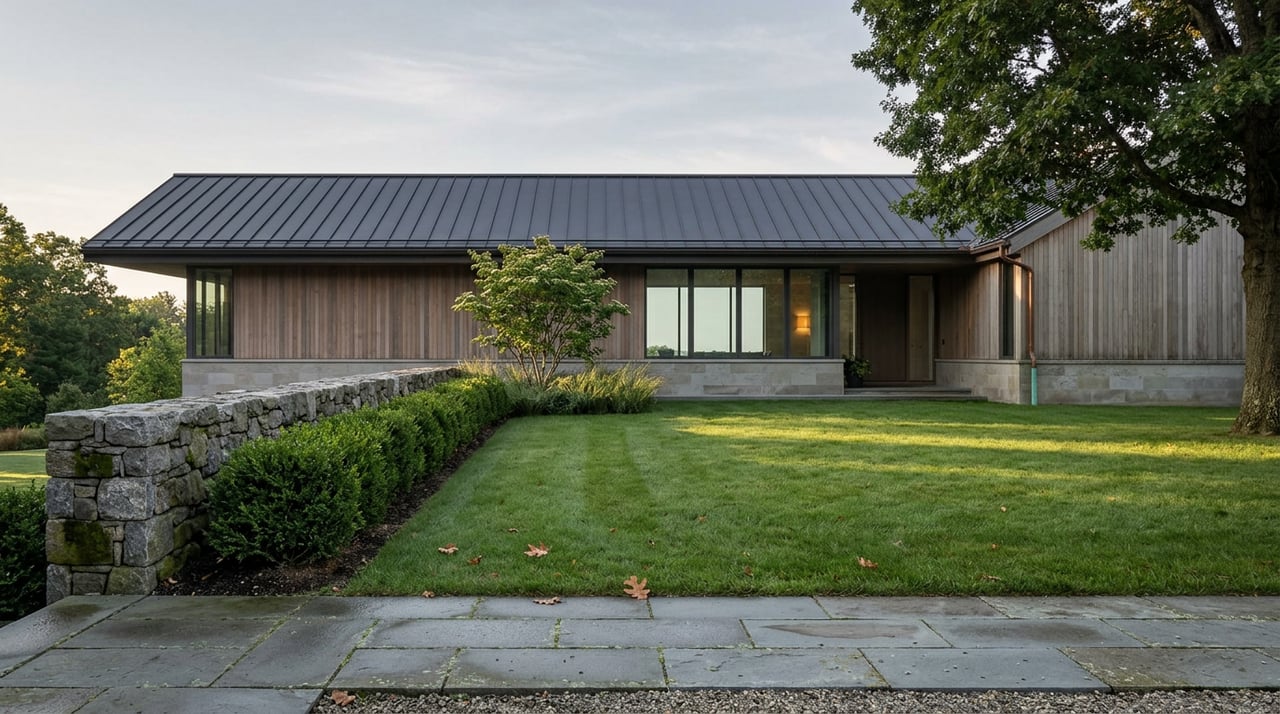
Two listings in Harding Township can both say "3.2 acres" in the same line of the same MLS sheet, in the same school district, on roads a quarter mile apart, and mean two completely different things. One might give a buyer a full acre and a half of usable, buildable ground once the house, driveway, and pool footprint are accounted for. The other might leave that same buyer with barely enough contiguous flat, dry, unwooded land to fit a three-car garage addition, because a stream corridor, a stand of protected mature trees, or a slope steeper than 12 percent quietly ate the rest.
Nothing on the listing sheet tells you which one you're looking at. The acreage field just says "3.2." The difference lives in Harding Township's own zoning ordinance, and it is the single most useful thing a buyer comparing New Vernon to other Morris County estate towns can understand before making an offer.
What "Three Acres" Actually Means Under Harding's Code
Harding Township's Rural Residential zone, which covers most of the large-lot land in and around New Vernon, sets a minimum lot size that can run to an average of five acres, with cluster subdivisions permitted down to three-acre minimums under the township's own design standards. Minimum lot frontage in that zone runs to 300 feet. Those numbers describe how big a parcel has to be to exist as a legal lot. They say nothing about how much of that parcel you're allowed to build on.
That's a separate question, and Harding's subdivision code answers it in a way most buyers never see until an engineer pulls the file. A proposed vacant lot in the township's R-1 and RR zones has to contain at least 1.75 acres of land free of wetlands, wetland transition areas, flood hazard areas, and slopes steeper than 12 percent, and of that 1.75 acres, only 10,000 contiguous square feet has to sit inside an actual usable building envelope. Ten thousand square feet is well under a quarter acre. On a three, four, or five-acre lot, that's the floor the township is legally willing to accept as "enough room to build a house."
Most lots clear that floor by a wide margin. Some don't, and the ones that come close are exactly the ones where a buyer needs to know the difference before falling in love with the acreage number.
The Easements the Listing Won't Mention
The reason the gap between deed acreage and buildable acreage opens up in the first place is that Harding's site plan and subdivision standards require permanent conservation easements over specific categories of land, and the list is broader than most buyers expect. Wetlands, transition areas, stream corridors, and stream encroachment areas are automatically subject to conservation easements under the township's design standards for both subdivisions and site plans. Beyond that, the ordinance gives the planning board discretion to require an easement over any "unique natural or environmentally sensitive area" identified during application review, and it specifically names mature forests, extraordinary steep slopes, hilltops, and scenic views as examples.
That last category matters more in New Vernon than almost anywhere else in Morris County, because scenic views and mature tree cover are exactly what a lot of these properties are being purchased for. A lot with a beautiful hilltop view or a stand of old-growth trees along the ridge line is often the same lot where the township is most likely to place a permanent restriction on building near that feature. The land is preserved specifically because it's the most desirable part of the parcel to look at, which is not always the same as the most useful part of the parcel to build on.
Add in a mandatory tree conservation area along the perimeter of every lot in the zone, plus steep slope development regulations that apply automatically in the R-1 and RR districts, and a buyer can end up with a legally compliant lot where the deed says one number and the site plan says something noticeably smaller.
None of this shows up as a red flag during a normal showing. It shows up when a buyer's engineer runs a lot grading plan, which Harding's own code requires whenever a vacant lot doesn't clearly contain 1.75 acres of unencumbered land.
What the Median Price Actually Tells You
Zoning explains why acreage is a slippery number in New Vernon. Price data has its own version of the same problem, and it shows up the moment you compare sources.
An early-2026 report built from Garden State MLS data covering March 2025 through February 2026 put Harding's median sale price at approximately $1,850,000, up 3.8 percent year over year, with homes averaging 42 days on market. Redfin's live data as of September 2026 shows a $2.1 million median listing price across Harding Township, with 17 recently sold homes and a typical 40 days on market, and notes that only four homes sold in the township in the trailing month. Niche's algorithmic estimate, by contrast, puts the median home value at roughly $1,181,000, a figure closer to a broader assessed-value calculation than an actual closing price.
| Source | Figure | What it actually measures |
|---|---|---|
| MLS-sourced report (Mar. 2025–Feb. 2026) | ~$1,850,000 median sale price | Closed transactions, GSMLS |
| Redfin (as of Sept. 2026) | ~$2,100,000 median listing price | Active/recently sold listings |
| Niche (algorithmic estimate) | ~$1,181,000 median home value | Assessed/modeled value, not sale price |
Three sources, three different numbers, all describing the same fourteen square miles of township. That's not a data error. It's what happens in a market this small and this varied when you try to compress it into one figure. One broker's overview of the township puts the actual sale range at roughly $600,000 to just under $4 million, with typical closings between $1.4 million and $2.2 million. A town where a renovated pool house on three landscaped acres and a 2005-built 8,772-square-foot colonial on 5.25 acres are both active in the same month is a town where "median" is doing a lot of work to describe very little.
With only four sales in a given month, one large estate closing or one smaller renovation project closing can move the median by a meaningful margin. That's worth knowing whether you're the buyer trying to figure out what a fair offer looks like, or the seller trying to figure out how your specific lot, with its specific mix of buildable and restricted acreage, is likely to be valued against a median that may not resemble your property at all.
What This Means Before You Write an Offer
The practical takeaway isn't that New Vernon is a difficult place to buy. It's that the two numbers that matter most, usable acreage and true market value, are both quieter and more specific than they look on a listing sheet or a market report. A buyer comparing a New Vernon parcel to a similarly sized lot in a neighboring town should ask, before writing an offer, how much of that acreage sits inside an existing or likely conservation easement, and whether a lot grading plan has already been done. A seller preparing to list should have that answer ready, because a buyer's engineer is going to find it either way, and it's better to control that conversation early than have it surface during attorney review.
The zoning ordinance and the subdivision code that govern these numbers are public record through the township, and the site plan or grading plan for a specific parcel is something any buyer's engineer can request as part of due diligence. Treating the deed acreage as a starting question rather than a finished answer is the difference between negotiating from real information and negotiating from a number on a page.
Frequently Asked Questions
Does every lot in New Vernon require a conservation easement? No. Easements apply to specific conditions defined in Harding Township's ordinance, primarily wetlands, transition areas, stream corridors, slopes over 12 percent, and any area a planning board identifies as a unique natural or environmentally sensitive feature, such as mature forest, a hilltop, or a scenic view. Many lots contain none of these conditions and carry no easement restrictions beyond the standard perimeter tree conservation area.
How do I find out how much of a specific lot is buildable before I make an offer? Harding Township's subdivision code requires a conceptual lot grading plan for any vacant lot in the R-1 or RR zone that doesn't clearly contain 1.75 acres of unencumbered land. A buyer's engineer can prepare or request this analysis, and the township zoning office can confirm whether an existing easement or environmental constraint is already on file for the parcel.
If you're weighing a property in New Vernon against another Morris County or Gold Coast option and want the zoning and market data read correctly before you commit to a lot, Scott Waldman can walk through the specifics with you. Let's Connect.


